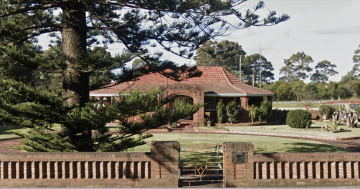
Sid Wearne, the manager of the Thirroul brickworks, of course had a blonde brick house. Photo: Supplied.
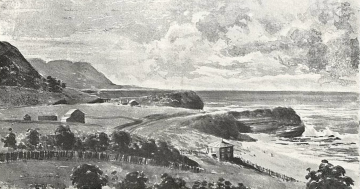
Something which has long interested me is whether ever a brickyard existed on the site of Headlands at Austinmer, despite the presence of such a place-name definitely appearing on some local maps.
But the question is why would one have been needed there? Thirroul’s Vulcan Brick Refractory – later called Newbold’s and still later Australian Industrial Refractories (AIR) – had opened in 1919 because a bloke named McCauley was searching for coal and hit clay instead.
As it turned out, it was clay with one of the highest silica contents ever found in Australia and it fired white under high temperatures. I grew up nearby and have long wondered if this brickworks ever had some claim to be being the birthplace of the blonde brick.
But what is today even more famous than Austinmer or Thirroul clay is Bulli soil. And the Sydney Cricket Ground is renowned for using it for its pitch.
Bulli soil is a specific type of heavy black clay that naturally creates a surface that is regarded as the most spin-friendly cricket pitch in Australia. Indeed, Bulli soil is so iconic that it was once a common practice to roll the SCG Bulli soil into balls to be presented as commemorative gifts to retiring trustees and celebrities.
But it was bricks made from Illawarra clay that assisted Illawarra’s most significant 19th century development: the construction of the Kiama to Sydney railway line in the 1880s.
As it turns out, in the 1880s many bricks for Illawarra rail infrastructure were supplied by Northern Illawarra yards utilising local clay seams – although not for the three million needed for the 1918-1920 Stanwell Creek viaduct sourced from the State Brickworks at Homebush because steel was unavailable due to WWI.
Thus it seems by 1884 Brickyard Point at Austinmer was once a genuine brickyard. And so was the Central Yard where operations were carried out on a larger scale with a 16 horse-power steam engine being included in the plant. At this yard a kind of shale was worked and the boss, Mr O’Mara, reckoned the bricks were “equal, if not superior, to any in the colony”.
Another yard was located “not far from the rear of the 1884 Bulli Court House” where “a kind of white clay is used”. Run by a Mr Berry, it was reported “the bricks manufactured from the Bulli white clay resembled pottery very much”.


There was also another brickyard at Clifton, also run by Mr Berry and called No 3. Although busy in July 1885, by July 1886 it was broken up and the railway contractors were said to be now “making bricks at Berry’s Yard, near the station, only”.
Bricks were also needed to build about a dozen water tunnels “between Clifton and South Clifton” for “the intended purpose of carrying off the flow of water from the upper side of the railway right away under the line to the edge of the adjoining cliffs”.
But, alarmingly, by 1892 only one of these tunnels had been completed to specifications: “Bricked throughout and acting splendidly in carrying the water away under the railway line. All the others were ‘timbered’ to keep them from falling in and two men in the railway service were continually employed as caretakers of them”.
The remarkable completion of the Illawarra railway line by 1887 also functioned as a kind of dam between the sea and the escarpment right across Illawarra. So it would appear that the creation of as many as 11 more brick tunnels under the rail line might well have been prudent.
Unfortunately, despite plenty of regular maintenance and improvements over the past 135 years, the northern Illawarra rail line still has difficulty coping with heavy rain events.
There were also other early brickworks in Illawarra apart from those in the north and I wouldn’t mind seeing examples from each, although especially one from Brickyard Point.
I even confess to having my own small collection, two of which are my favourites.
One emerged during the construction of Crown Street Mall. It dates from about 1842 and bears the love-heart mark of either an Illawarra convict or indentured labourer. It may well be the oldest surviving ceramic in Illawarra.
The other is a massively heavy (and possibly toxic) rather ugly brick from the now demolished giant copper-smelter stack at Port Kembla.
Strangely I’ve found I am not alone in my madness – just this month I discovered a “Brick Collectors of Australia Facebook Page” with some 2000 members.