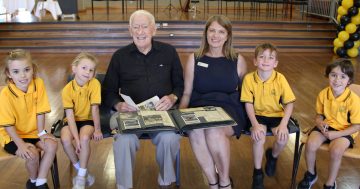
Wollongong West Public School students Simrah, Vanya, Sama, Dalia and Theordora are embracing their cultural roots. Photo: Keeli Dyson.
An Illawarra primary school is celebrating its incredibly culturally diverse cohort of children and the unique value their backgrounds and experiences bring to the school environment.
Wollongong West Public School is a snapshot of the world, boasting students from vastly different cultures and dialects, with almost half the school population learning English as an additional language.
“We have children coming from over 20 different countries throughout the world and who speak over 46 different languages at our school, which adds to the really rich tapestry and diverse community here,” principal Michelle Barnes said.
As well as a 12 per cent Aboriginal population, families from Australia, India, Pakistan, Lebanon, Syria, China, Ethiopia, Nepal, Saudi Arabia, Sri Lanka, Egypt, Iran, Iraq, Turkey, Burma, Kenya, the Philippines, Thailand, Uganda and the United Arab Emirates have come together at Wollongong West, with students showing immense pride in their traditions, languages and flags.
Eleven-year-old Vanya Edussuriya only arrived from Sri Lanka nine months ago.
“It’s a really unique culture and it’s very different from other cultures and we have a lot of different activities known for our country,” she said.
“Our Sri Lankan flag is also very different because it has a lion holding a sword which means bravery and there’s colours that symbolise different religions because our country is a multicultural country.”
Sama Alsamirae, also 11, said she loves her culture. Sama was born in Dubai after her family moved from Iraq.
“We have all of these celebrations and things that I like doing like Ramadan where we fast, or Eid and we celebrate,” she said.
“I first came to Australia when I was two years old so I don’t really remember much about my past.
“I partly speak Arabic – I’m still learning because my siblings really wanted me to know how to speak English since I was coming to Australia so they mostly spoke in English in front of me and I’m still trying to learn Arabic a bit more.”
The children’s faces lit up as they showcased their outfits, some of which were traditionally worn for weddings, festivals and events.
“I wore this dress on Eid, it’s very detailed and on the back there are some birds,” eight-year-old Dalia Abdulhameed said, whose family is from Iraq.
“You have to be very careful with these because they’re very special.
“When I put it on my teacher and everyone were like ‘woah, so fun’ and I instantly had butterflies in my stomach.”
Many students who were born in Australia or travelled here when they were very young were eager to learn more about their heritage and connect to their family’s past.
“I’m from Australia but on my mum’s side of the family is from Scotland,” Theodora Arnold, 9, said.
“She told me a lot about Scotland – I think it’s really cool and I haven’t actually been to Scotland but it makes me really want to go.”
For 10-year-old Simrah Ilyas, the extreme change in weather was not the only shift she experienced when she moved from India a year and a half ago, with the multicultural cohort a unique feature of the Illawarra school.
“When I first came to school I thought it was mostly different than my country,” she said.
“The difference was with my friends – in my country they were like all Indians, Muslim friends and here it’s all different kinds of people.
“I like to mix with friends from the other countries and learn about their culture like ‘what do you do?’.”
The transition for both children and families is made easier with support of welcome packs, interpreting services, multilingual resources and even bilingual teachers, with students encouraged to embrace their first language while learning English.
“We really value that home language that the children are bringing to school and we make sure that children are not only learning English but that they’re also learning through their first language,” Ms Barnes said.
And it’s not just academic support, with sensory rooms, sensory tools and support dogs helping support students’ wellbeing, particularly those who may have experienced trauma or from refugee backgrounds.
“Learning and wellbeing go hand-in-hand, they’re not mutually exclusive and so it’s very important that from the moment that family walks through the school gate, they’re welcomed,” Ms Barnes said.
While Harmony Day celebrations provided another opportunity for students to connect with their culture and the culture of others, diversity is at the forefront of the school all year round.
“I’d like to think that it’s Harmony Day here every day, where diversity really is Wollongong West Public School’s greatest strength,” Ms Barnes said.
“Diversity is something here that is not just acknowledged or tolerated, it’s something that celebrated and valued every single day.”