
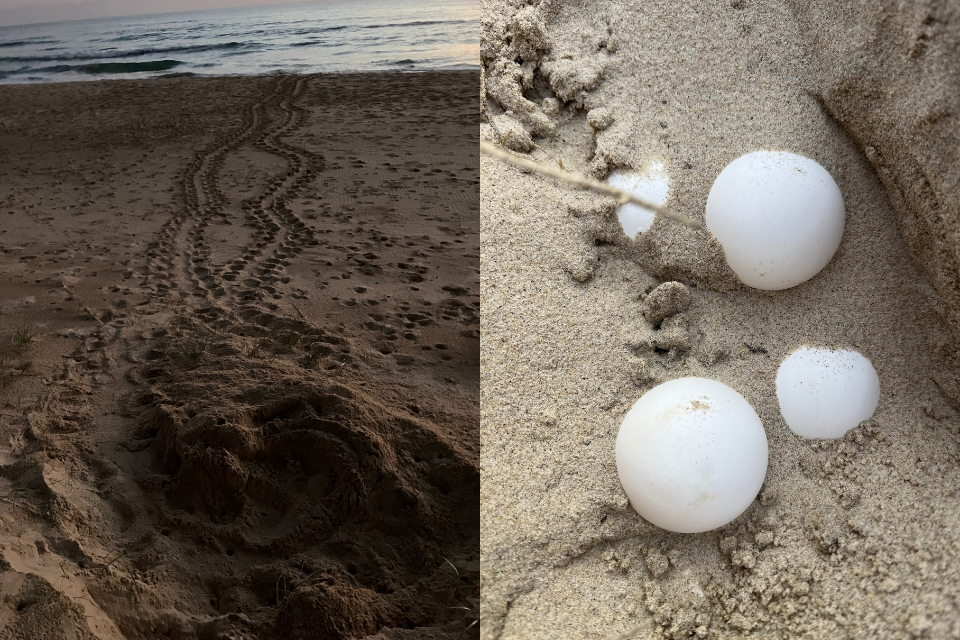
(Left) a successful nest with visible turtle tracks and (right) turtle eggs. Photos: Merryn Dunleavy.
Until sometime in March, what you might mistake for tyre tracks through the sands of your local beach might be an indication of something more precious (and a whole lot cuter) than any 4WD.
TurtleWatch NSW is calling for volunteers to walk beaches, including those of the Illawarra, to look for turtle tracks after the season’s first turtle nest was spotted by a member of the public on the NSW North Coast in November.
The exciting find kicked off the start of the state’s sea turtle nesting season, following last year’s record of 18 sea turtle nests successfully hatching. However, this first nest was too near the water’s edge and needed to be moved to save the eggs from drowning.
Specially trained and licensed TurtleWatch staff carefully placed the eggs into one of the cooler-box incubators used during last season’s record incubation success, highlighting the potential impact the public can have on a successful turtle season.
TurtleWatch says volunteers could play a vital part ahead of what could be a challenging season for nesting turtles.
Prompt reporting of turtle tracks, low-lying nests and community awareness are key to protecting eggs and giving them the best chance to successfully hatch, according to TurtleWatch NSW’s Merryn Dunleavy.
“Every nest that’s reported becomes one we can safeguard, and the commitment and care from our coastal communities will be essential in ensuring these nests can survive,” she said.
“We are asking beachgoers to become citizen scientists and monitor local beaches along the NSW coastline, from the Tweed to Batemans Bay, looking for nesting sea turtles.”
Turtle nest spotting can be easily incorporated into a person’s morning walk.
“Walk your local beach early in the morning along the high-tide line looking for turtle tracks in the sand, as sea turtles generally nest during the night, from dusk until dawn,” Merryn said. “They are usually 80-100 cm wide and can sometimes be mistaken for tyre tracks.”
If you come across a turtle nest, do not disturb it. Leave it for wildlife experts to determine whether relocation is necessary.
Earlier this year, ex-Tropical Cyclone Alfred reshaped large sections of the northern NSW coastline, washing away gently rising sandy shores.
In some areas, dunes were cut back several metres, reducing suitable nesting habitat by creating steep drop-offs that nesting females couldn’t climb.
Thanks to the Turtle Team’s vigilance in February, National Parks and Wildlife Service (NPWS) and TurtleWatch staff rescued more than 1000 eggs from nine nests ahead of the cyclone. After hatching, they were released at their original nest sites, and 1020 hatchlings ultimately swam free.
NSW TurtleWatch and NPWS monitor and protect turtle nests under the Marine Estate Management Strategy.
To find out more about joining the TurtleWatch team, email [email protected].