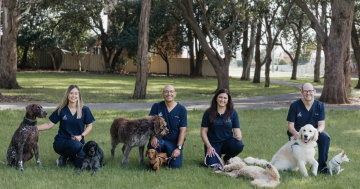
No more treats! Leo is on a diet, with the four-year-old cavalier needing to lose a quarter of his total weight. Photo: Keeli Dyson.
A few extra kilos could have serious health implications for beloved family pets, with vets warning owners to keep watch of their furry friends’ weight as they see more cases of obesity amid lifestyle changes within the community.
Having a chubby dog or fat cat may make for a cute photo, but excessive weight gain and obesity could be putting your pet in danger.
“It does have significant effects on their health and now we know their lifespan as well,” Fairy Meadow Greencross vet director Dr Joe Mallat said.
“It’s not just a ‘cute thing’, it’s not just ‘my dog loves food’, it does have real ramifications, and while you may not see it when your dog is young or middle-aged, I can pretty much guarantee that we will run into issues as they get older.”
A pet is deemed overweight if it’s up to 20 per cent heavier than its ideal body weight, while anything more than 20 per cent is considered obese.
Finding the benchmark may seem difficult, but there are signs that you can assess at home.
“There is so much variation within breeds, and then we’ve got so many crossbreed dogs out there now as well,” Dr Joe said. “Some labradors, their ideal bodyweight might be 30 kilograms, others might be 25. It depends on their genetics, their stature or so on.
“If you look at your pet and do a distance exam from the side, you want to see a tuck or a bit of a waistline in their abdomen or groin region, it shouldn’t be a flat straight-across barrel appearance.
“You should also be able to feel the ribs and the spine. If you can’t feel any ribs or spine, which are bone, then your pet’s probably overweight.”
He said any dog could be overweight, but it seemed to be more common in some breeds.
“Different breeds and all dogs have different temperaments,” Dr Joe said.
“If you have a kelpie or a working dog like a border collie and they tend to be very active and have a fast metabolism, they’re less likely to become overweight.
“Dogs that can be a little bit lazy, like labradors and pugs, and also love their food are probably more commonly overweight.”
More than 40 per cent of pets in Australia are estimated to be overweight, with the implications impacting all areas of health and quality of life, from insulin resistance to inflammation causing urinary tract problems like bladder stones, as well as being more prone to joint disease and arthritis.
“When there’s more weight and force going through the joints, there’s more of a predisposition to developing arthritis,” Dr Joe said.
“We also see obese dogs more commonly have ACL injuries, so that’s the kind of cruciate ligament in the knee, and we commonly see that rupture in obese dogs.”
It can also increase the risk of cardiovascular disease and cancer.
“Dogs can have heart problems and lung problems just like people can if there’s fat around the heart and in the chest and abdomen,” Dr Joe said.
“There is an overrepresentation of obese dogs that develop different tumours and cancers, particularly as they get older.”
Despite all these dangers, Dr Joe said he’d seen an increase in overweight and obese pets presenting to vet clinics.
“Most vets, myself included, feel like overweight pets and obese pets are becoming more and more common,” he said.
“That could be due to several factors: one is dogs becoming less active, especially in cities and urban centres where they live in units and apartments; two is as they become more and more part of the family, there’s a tendency to overfeed them.
“Dogs don’t know their limits, especially dogs that love food. They’ll eat and eat and eat until you stop giving it to them.”
But although getting your pet to lose kilos may sometimes seem like an impossible task, Dr Joe said with the right guidance and support, they could return to a healthy weight and improve outcomes.
“While it seems sometimes too hard or even a little bit embarrassing to accept that your dog needs to lose weight, no vets hold any judgment about that. A lot of vets know how difficult it is and we’re here to help,” Dr Joe said.
“If there’s any doubt about your pet’s weight, or even if you just want to have that assessed, I always think it’s best to have a consult with a vet — we see them day in, day out, we know what a pet at a good weight is, we know what an overweight pet is and we can formulate a plan.”