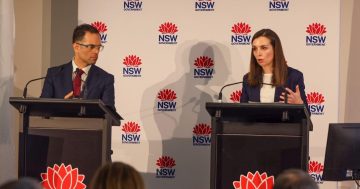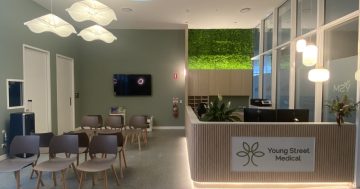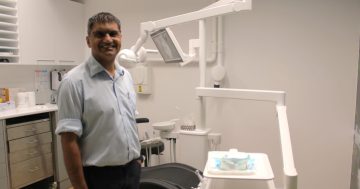


Rehana Kermali (left) is proud to now be able to offer bulk billing for more patients at King Street Medical. Photo: Keeli Dyson.
A Warrawong GP practice has returned to 100 per cent bulk billing for consults and certain procedures to offer more accessible care for patients, but although government incentives have improved the viability of the offering, not all practices are expected to follow suit.
King Street Medical opened in the peak of the pandemic as a fully bulk-billed service, but without improvements to rebates or incentives, the centre shifted to mixed billing two years later.
It continued to bulk bill consults for more vulnerable community members, such as children, pensioners, concession cardholders and First Nations people, and charged around a $35 gap for all other patients.
But now the offering is coming back to make healthcare more affordable for everyone.
“There are circumstances where I’m sure people avoid going to see a doctor because maybe they can’t afford those gap fees,” King Street Dental and Medical co-owner and operations manager Rehana Kermali said.
“We never want to see that happen, but at the same time, as a practice you still have to run and operate.
“We’ve always provided the highest standard of care for our patients. We moved to seven days a week a few years ago, we have extended hours on the weekend as well, so we try to be very accessible for our community and our patients, and now with the affordability being completely 100 per cent bulk billed for GP consults, we can provide all of that.”
The move was made viable through new government incentives introduced in November, but there were still many logistics to work through.
“They introduced a bulk-billing PIP [practice incentive program] payment, which is split between the practitioners and the practice, which is an incentive for the entire practice to go bulk billing for all eligible consults,” Rehana said.
“In order to receive that extra incentive, every GP in the practice had to agree to bulk bill.”
Executive chair Brad Neilson added: “Getting that alignment is not easy at times, it’s not straightforward, and that’s why we had so much stakeholder engagement.
“We’ve had to look at our remuneration model because our objective was that no general practitioner would be worse off under these changes, and that was a commitment we made to ensure we could meet our values.”
New data from the Australian Institute of Health and Welfare shows the region’s percentage of GP attendances that were bulk billed throughout September 2025 fell below the state average of 82 per cent, with Shellharbour recording a rate of 80 per cent, Wollongong of 77 per cent and Kiama 70 per cent.
Those percentages are all about 10 per cent lower than what was recorded 10 years ago.
And in all three local government areas, the rate for those aged 16 to 64 was significantly lower than both older and younger cohorts, but that number could be lifted if more practices expand bulk billing to everyone.
“What we find is for people in their 20s and 30s trying to make their way in life and have families, it can be very difficult for them to have affordable care and they tend to avoid potentially going to see a general practitioner because they might be paying a $40, $50, $60 gap fee to see a doctor,” Brad said.
“In my view, it was very important that that cohort of patients was able to benefit from affordable care.”
But just because the change was suitable for King Street Medical, it doesn’t necessarily mean there will be widespread adoption.
“For a smaller practice that’s very well established with a well-understood patient base in an affluent suburb, they won’t necessarily want to go away from private billing — they want to stay the way they’ve always done it because it’s a way that they can remain profitable,” Brad said.
“With medium size, if the general practitioners say ‘No, we won’t support this’, and they have every right to, then that practice is constrained by their ability to move to bulk billing.
“It’s a very dynamic market and not one-size-fits-all in terms of the drive towards bulk billing.”
While the Warrawong practice is ticking the boxes to meet the criteria for incentives, it has also gone a step further by including some procedural appointments within the bulk-billing guarantees.
“Things like women’s contraception, insertion and removal of IUD or hormonal implants, also ingrown toenail resection, ear microsuction,” Rehana said.
“All of these procedures, they don’t need to be bulk billed under incentive, but our GPs actually suggested that we should be bulk billing them.”
And it has already proven to be another drawcard for the medical centre, which also boasts dental and skin cancer clinics as well as a newly opened pharmacy.
“We have had an overwhelmingly positive response from our patients and a lot of new patients that want to come to the centre,” Rehana said.
“We are actively getting a number of new GPs to join our practice from 2026 to be able to meet all of the patient demand.”
For more information, visit the King Street Dental and Medical website.