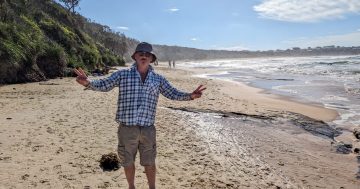
Warren Grosse is back playing golf three months after receiving a new liver. Photo: Supplied.
Warren Grosse considers himself the luckiest man alive after hitting the jackpot in a high stakes lottery.
Three months ago the Kiama man won the gift of life after a successful liver transplant.
In 2024 doctors found 16 tumours on Warren’s liver and, when his treatment options failed, he joined the almost 2000 Australians on the nation’s organ transplant list.
Warren had been managing his chronic liver disease with diet and medication for several years before his prognosis turned deadly.
He underwent a series of procedures to “microwave and burn the cancer out of the liver” at Sydney’s Royal Prince Alfred Hospital but it was a band-aid fix that bought him some time until a donor liver could be found.
For two years Warren and his wife Pam lived “in a holding pattern” waiting for a life-saving phone call to say a match had been found.
Despite getting sicker by the day Warren tried to stay hopeful, his mantra to his family was “bubbles up”.
“Bubbles always rise, hope never fades,” he explains.
But Warren and Pam soon learned that false starts are commonplace for transplant patients and the emotional rollercoaster is a bumpy ride.
“We came close three times,” says Pam. “Once Warren was even prepped and on the bed ready for surgery but in the end it wasn’t a match.
“That third time when we were told it wasn’t going to happen was like a punch to the gut. The air went out of me. It’s the first time I ever really thought ‘we’re not going to make this’.”
Then on 19 April, Warren and Pam got the life-changing news they had been desperately hoping for – a successful donor match.

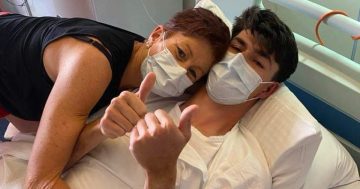
Pam and Warren Grosse and their children Joshua and Willo celebrated the Kiama man’s successful liver transplant with a packet of chips. Photo: Supplied.
After a six-and-a-half hour operation, Warren was given a new liver and a new life.
“The wards are full of people who won’t make it, but I was one of the lucky ones, there are many others who aren’t,” says Warren.
“One lady who was getting treatment with me wasn’t eligible because she was over 70 and they are reluctant to do a transplant at that age.”
Warren is 69.
“I just squeezed in, and I am so grateful,” he says. “I was already the luckiest man alive. I have a beautiful wife, two great kids and seven wonderful grandchildren. My new liver has given me time to enjoy them.”
But like many transplant recipients, a part of him feels guilty.
“Someone else had to die for me to live,” he says tearfully. “But you accept this precious gift and vow to look after it by staying healthy and making the most of every moment.”
Warren says he would love to meet his donor’s family but knows this is not allowed, for privacy reasons. Instead he has penned a heartfelt letter thanking them for giving him “a new birthday”.
“Your wonderful commitment to organ donation has given me the two most valuable gifts in the world; health and time,” he wrote.
The former school principal is rarely lost for words but Pam says writing to his donor’s family “took him about 15 drafts”.
“It was a very hard thing for him to do, and there have been a lot of hard things over the past six years,” she says.
“At the end of the letter I had to write ‘PS sorry for the printing, my hand was shaking the whole time I wrote this’,” says Warren.

The former school principal is rarely lost for words but writing to his donor’s family was difficult. Image: Supplied.
“There have been some sleepless nights because I know this precious gift came at a high cost.”
This week is DonateLife Week, a nationwide campaign by the Australian Organ and Tissue Authority to encourage more people to become donors.
While 80 per cent of Australians support organ donation, only 35 per cent have joined the Australian Organ Donor Register, which replaced the drivers licence organ donation scheme in all states and territories except South Australia.
The Festival State has double the national average of donors at 74 per cent and a charity supporting donor recipients and their families, Transplant Australia, believes a nationwide linking of drivers licences with the Australian Donor Register could result in 200 more transplants each year.
Warren is sharing his story to educate more people about donor registration and to give others on the transplant list a second chance at life.
“People need to be more widely informed about how to join the donor registry, now that it’s no longer linked to their drivers licence,” says Warren.
“Donor registration is a tough conversation to have with your family because no-one wants to talk about dying,” says Pam. “But we had to have that conversation because it was a reality we faced everyday until Wazza got a liver.
“Against our psychologist’s advice, we talked about it with our grandkids because we wanted them to be prepared if the worst happened. One of them even made Wazza a magic liver potion filled with her wishes for him to find a donor match.”
Warren’s successful transplant means the couple can now fulfill some of their own wishes, including taking all seven grandchildren on a road trip to Orange, which they did in the recent school holidays. A family holiday swimming with the whale sharks at Ningaloo is also on the cards.
“Before I got this transplant we couldn’t travel more than two hours from the hospital,” says Warren.
“Now we can book a holiday and travel to see family, do all the normal things that people take for granted.”
Warren is back playing golf with Pam and his mates and was quick to tick off one long-held wish while still recovering in hospital.
“I got to eat a packet of Smiths chips because I don’t have to be on a low-salt diet anymore and they tasted so good,” he laughs.
People can sign up to become an organ donor through the Australian Organ Donor Register, their myGov account, the DonateLife website or by calling 1800 777 203.