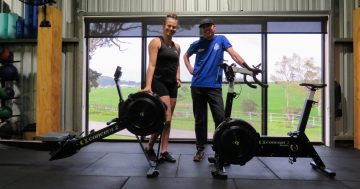
Nardia Guillaumier and coach Alan Swan at the end of a nail-biting second race. Photo: Nardia Guillaumier.
The sun had not yet risen when Kiama’s Nardia Guillaumier crossed an invisible finish line and claimed her second gold medal for the day.
It was the fourth consecutive year the athlete had placed in the World Rowing Virtual Indoor Championships, which sees elite athletes from around the globe competing on rowing machines connected to a racing data portal.
But a few things were different this year.
For starters, Nardia had only months earlier celebrated a birthday that graduated her into the 50-54 open weight division. And while last year she had claimed gold and bronze in the 45-49 Women’s Heavyweight division’s 2000 m and 5oo m respectively, this year she had taken on a heart-stuttering one-minute sprint at the unholy hour of 1:43 am, followed by the gruelling 5000 m distance event at 4:10 am.
Most elite rowers train for either sprints or long-distance events, but Nardia didn’t want to be pigeonholed.
It presented a unique challenge for her coach, Swan Athletic owner Alan Swan, who said the wildly polarised nature of these two events required two different training regimes and two different race-day strategies.
“A lot of the challenge is shifting your mental approach,” he said.
“For a sprint it’s power, aggression, speed. Training is brutal and nasty. They’re over in a hurry, but they hurt.
“For the 5 km, it’s close to 20 minutes spent teetering on the edge. We worked hard on staying calm, going as hard as you can without getting too mentally stressed.
“Winning gold in two such different disciplines was a pretty big achievement.”
Digging deep to pull out your best performance is hard at the best of times, let alone at the unsociable hours often part and parcel of international virtual events.
Nardia, who would usually eat a couple of hours before a race, woke at midnight and choked down about three spoonfuls of a banana and rolled oats before warming up for the sprint.
Post-sprint, she employed techniques used during training to calm herself down. An Anzac biscuit and a Hydralite were all she could stomach before race number two.
Fatigue from the interruption of a regular circadian rhythm and sub-optimal sustenance meant a less-than-ideal physical readiness — not to mention the mental challenge.
“Psychologically, you’re questioning if you’re 100 per cent prepared because you haven’t done the usual things you would in the lead-up to the event,” Nardia said.
“Warming up for 40 minutes for a one-minute race at that hour, your body is in a daze. You’ve got to really push to bring yourself to that ‘race focus’ state. By the time you’re sitting in that seat, your body is producing a cocktail of cortisol and adrenaline.
“When the race is over, you don’t know if you want to sing, dance, throw up or eat.”
In a virtual championship, you don’t see your competitors in the next lane. Racing against digital ghosts was no less nerve-racking, but Nardia and Alan had their plan.
It was an unconventional strategy for a distance race, but it paid off in the game of cat and mouse that ensued, with Canada’s Anne-Marie Fequet maintaining a distance of between eight and 22 m at all times.
Alan coached from the sidelines, updating Nardia with the split times of her nearest competitor. Nardia watched her closely.
“I was glad not to be doing the chasing — just responding to their challenges,” Nardia said.
“Fequet was not giving up easily.
“I needed to draw on every ounce of training.”
In the end, Nardia won by about 15 metres.
“It was 3.9 seconds — not huge,” she said.
Alan said while there were definitely commonalities between elite athletes, each had unique strengths.
Nardia’s lies in her motivation.
“Her ultimate goal is to extract every possible ounce of effort out of herself,” he said.
“That’s a very pure goal because if caught up in the competition, that might not be a motivation to extract the best out of you, because you mightn’t have to be your very best to win.
“Nardia isn’t as content with a gold medal as the end goal, which is to push the limits of what she’s capable of.”