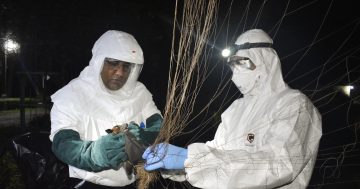
Baby flying foxes are suffering across the state, with pregnant bats unable to carry to term. Photo: Shoalhaven Bat Clinic.
Hundreds of prematurely born flying foxes have been dying along the state’s east coast, prompting investigations and putting pressure on rescue organisations, with more deaths expected to come.
Late last month Wildlife Rescue South Coast received a few strange reports of dead baby bats and oddly behaving flying foxes.
But the rare occurrences quickly escalated into a crisis.
“We were getting some calls about bats feeding in mulberry trees in the middle of the day, so we started making some assessment calls and just checking in on them,” Wildlife Rescue South Coast and Shoalhaven Bat Clinic coordinator Trista Thorpe said.
“We couldn’t see that there was anything wrong and then within 24 hours it turned into dead bats underneath mulberry trees everywhere.
“It just spiralled out of control basically from the 26th September.”
The rescue organisation has since been inundated with callouts.
“What we’re seeing is the females are having their babies prematurely and the babies are too premature to survive – so there’s a lot of loss there,” WIRES veterinarian Dr Vere Nicolson said.
“We’re getting reports from Northern Rivers right down to the mid South Coast, so it seems to be right down the whole east coast.
The mass casualties are most likely caused by starvation, with the breeding bats unable to carry their pregnancies to a viable stage.
“Their main food source is the eucalypt blossom and our bloodwoods last year actually flowered three times between November and May which is very unusual, and then we ended up with a really dry, warm winter,” Trista said.
“So I think what did come out in spring didn’t actually yield much nectar and then our maternal colonies all started to congregate down here … and because the numbers increased and the food availability wasn’t there – then competing factors like birds and other nectar eaters, quite possibly also the migration of the moths may have also impacted the nectar supply as well, and just very quickly there was no food left and they just started suffering.”
“When conditions are right, forests of eucalypt trees just flower prolifically and flying foxes migrate or are vagrants – they travel around to where the food is,” Dr Nicolson said.
“So if there’s been a decent rain event, they’ll go hundreds of kilometres to capitalise on that and there’s usually somewhere to go except some years there isn’t.”

Dead bats have been found lying beneath fruit trees, with rescue organisations being called about even more that are sick or suffering. Photo: Shoalhaven Bat Clinic.
Investigations are still underway to better understand the situation and confirm that nothing else is happening simultaneously.
“Recently flying foxes have been suffering from a thing called Flying Fox paralysis syndrome and a very similar thing happens in lorikeets in the same weather conditions, so there’s something in the forest that’s producing toxins that’s paralysing both these species … it could be a variation of that syndrome,” Dr Nicolson said.
“Things like toxoplasmosis can also cause all sorts of species to lose their pregnancies.
“There’s a few other things that need to be looked into but at the moment it seems like a starvation event is a really good working hypothesis.”
Although the state’s cases of bird flu are climbing at the same time, these deaths are not believed to be related.
“There isn’t any indication at the moment that that’s got anything to do with it,” Dr Nicolson said.
“That’s probably something they’ll look into when they’re looking into the other things as well but it’s not really what we’d be expecting to see if bird flu got into flying foxes.
“Mammals that scavenge bird carcasses are the most likely to be affected with bird flu first, so flying foxes being vegetarians are probably well down the list of things that have any trouble with bird flu.”
The age of the premature babies being found indicates that more deaths could be imminent, with numbers potentially reaching the thousands.
The animals could face more strife throughout summer.
“They’re already dealing with habitat destruction; a lot of the forests they used to feed on and pollinate are now cleared,” Dr Nicolson said.
“There’s urbanisation that doesn’t necessarily work in their favour.
“We’re getting heat events now due to climate change where there’s big numbers of flying foxes dying.
“With the El Nino this year, they’re predicting that there may be mass deaths due to heat, and now the babies are being lost as well – that’s the next generation.”
The community is being warned against touching or feeding the animals.
“There is a tiny percentage of them that may be carrying lyssavirus which is fatal to humans,” Dr Nicolson said.
“I know that there’s many well-meaning people that want to help but if they’re scratched or bitten by a live bat, the bat needs to be euthanised to be tested, it’s a legal requirement, so they’re better off not touching it.”
Feeding a whole population is not only unfeasible but could also do more damage.
“I wouldn’t condone hanging food for them; it actually makes it a lot worse,” Trista said.
“If you start to make them dependent on coming down that low for food source and being provided more food it just puts them at more risk and us at more risk of coming into contact with bats that may have lyssavirus as well.
“There’s definitely nothing short term that anyone can do except to try and support all of our volunteers and these rescue groups that are now having to deal with this mass mortality and this increase of animals in care.”
More information and updates on investigations will be released on the Wildlife Health Australia website.