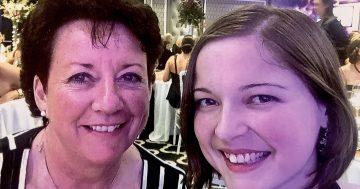
Thirteen-year-old Harper Patterson is searching for a stem cell donor to cure a rare disease and the Illawarra Stingrays are rallying behind her. Photos: Keeli Dyson.
A three-minute, non-invasive mouth swab at a community football day could change the lives of people in a similar position to Illawarra Stingrays player Harper Patterson, with the 13-year-old in desperate need of a stem cell donor to cure her rare immune disease.
When Harper is out on the football field, she’s just like any other young teen, thriving in her sport while surrounded by friends.
“I just like having fun with my team; it’s a good bunch of girls and they’re very supportive,” she said.
But living with a rare immune disease means illness can quickly strike and escalate, stopping her from doing the things she loves and living a life like a normal kid.
“It’s a bit sad when I can’t see them and I get a bit lonely every now and then,” Harper said.
Less than two years ago, a lump on Harper’s neck led to a devastating diagnosis.
After a struggle to find answers through biopsies, medical investigations and specialist appointments, it was the infectious diseases team at Sydney Children’s Hospital that discovered the reason for the lump and her constant illnesses.
“They did scans on her lungs to check out the other lymph nodes in her body and they initially thought it was lymphoma,” Harper’s mum Natalie said.
“Then they tested her for some really obscure diseases and it turns out she’s got chronic granulomatous disease or CGD, and it’s just an inherited immune defect so essentially her neutrophils or her white blood cells don’t work.
“She will just get every bacteria and every fungal infection – she’s always got pneumonia and she’s just always sick.”
The condition means Harper needs to avoid certain areas and activities because of her higher susceptibility to diseases, and things will only become more difficult as she gets older.
A stem cell transplant could cure her, but finding a match is extremely difficult.
“It’s all based on heritage rather than blood type,” Natalie said.
“They’re called the HLA markers, so it’s depending on your background to how you get a match.
“Everyone has about 10 markers and to get 100 per cent you have to be matching all 10.

The close-knit club has helped support Harper through her journey.
“Because Harper’s got Aboriginality – it’s very localised to Australia.
“There’s a massive worldwide register that’s got like 43 million people on it but in Australia there’s only 190,000 people on it.
“It’s a bit of a needle in a haystack.”
Despite the incredible, lifesaving impact a transplant could make, there is still a lack of awareness and misinformation around what it entails.
“There was an old stigma that you’d be getting this big jab in the hip and you’d be awake and it’d be painful whereas now 90 per cent of the cases it’s just like a long blood donation, like a six-hour blood donation, where they take the stem cells out and the rest of the blood product goes back into the body and your body just regenerates it,” Natalie said.
“It’s a really easy thing but people are just scared I think, and they don’t understand how important it is.
“There’s so many kids waiting for a match and they could just give someone another chance.”
Every additional donor on the registry gives children like Harper a better chance. Her football club the Illawarra Stingrays decided to step up to help boost the numbers by inviting the whole community, businesses and other sporting clubs to a swab testing day at their home ground.
“The community part of it is very much in the club’s DNA,” Illawarra Stingrays board member Danielle Ozolins said.
“I think it’s such an easy thing for us to do to just help people.
“If people can just pop in throughout the day – what an amazing thing to do, not just for Harper, because there mightn’t be a match for Harper, but they might be a match for someone else.”
People aged between 17 and 35 could be eligible to join the Australian Stem Cell Donor Registry, and it only takes a cheek swab and a few minutes to be put on the list – no needles or blood tests are needed.
Stem Cell Donors Australia will be ready to make the process as easy as possible and answer any questions during the Hope for Harper Donor Day at Lakelands Oval in Dapto from 8 am to 5 pm on Sunday 16 August.
“If we can match one or two people, then that’s a huge success,” Danielle said.
“It’s just hard when you know how easy it is and people just aren’t aware,” Natalie said.
“I think more people would do it if they just understood the importance.
“I know that because of her heritage we may not get that match but we will find people matches just by doing this, so it makes you feel better about it that it’s not just in vain.”
If you can’t make it on the day, a swab can be sent out to your house or an additional sample can be taken during a regular blood donation.
For more information about eligibility or to pre-register for the Hope for Harper Donor Day visit the Stem Cell Donors Australia website.
Updates and more on Harper’s story is available through the Register for Harper Instagram page.