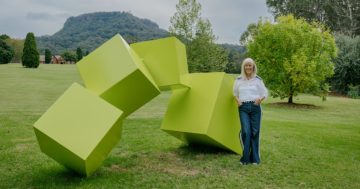
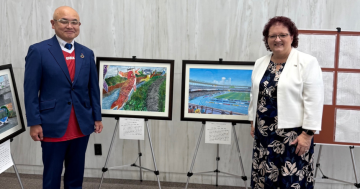
The competition invites entries that reflect what life in Wollongong looks like today, from its people and places to neighbourhoods and everyday moments — like these azaleas on Margaret Street, Balgownie. Photos: Wollongong City Council.
A manicured front lawn punctuated by a row of four vibrant azalea bushes; the stark corner of a 1960s red-brick home contrasted by a modern four-wheel drive parked in the carport.
More candid snapshot than professional gallery piece, this is precisely the kind of photo that could place in the inaugural Illawarra Images Photography Prize, according to Juliet Beale.
As Wollongong City Council’s Service Team Leader for Local Studies, Juliet explained that the judges weren’t hunting for technical mastery or an expert artistic eye. Instead, they were searching for the authentic story of life in Wollongong in 2026, captured through the eyes of the people who live it.
“People are always asking about life 10, 20, 100 years ago. How did we live, shop, get to work?” she said.
“This is about documenting people’s experience of what it means to live in Wollongong right now. It could be the street you live on, the traffic jam on the bus ride to school, the cafe you walk past on the way to the dog park, the clothes people are wearing, the queue outside Yochi, the building that was torn down or the new one that went up.
“It’s hard to say which moments in this time will be of interest to people 30 years from now, so it’s about capturing all of it.”
With dedicated categories for kids, teens, and adults, a total prize pool of $2000 is up for grabs.
But far more than a simple photo contest, the prize offers residents a unique chance to help build a rich, diverse visual archive of life in Wollongong for future generations.
Selected entries will be added to Illawarra Images, Wollongong City Libraries’ collection of more than 50,000 images spanning the 1800s to today.


Wollongong Lord Mayor Tania Brown noted that the prize underscored the vital role the community played in preserving local heritage.
“Our libraries are at the heart of preserving Wollongong’s story and initiatives like the Illawarra Images Photography Prize invite our community to be part of that legacy,” Cr Brown said.
“What makes this initiative so special is the opportunity to capture the diverse, everyday experiences that might otherwise go unseen or untold, and the moments, communities and perspectives that truly reflect who we are as a city.
“Every photograph tells a story, and by sharing these moments, residents are helping build a richer, more inclusive picture of Wollongong that future generations can connect with and learn from.”
Replacing the traditional Local History Prize for a trial period, this new initiative reimagines how local history is gathered, with organisers encouraging residents of all ages to step up as “citizen collectors.”
“We hope that photography will open it up to a wider pool of participants, and make contributing really accessible,” Juliet said.
To catch the judges’ attention, successful entries should steer clear of generic, stock-style photography and aim for something unique and specific.
“We’re not looking for pretty landscapes and artistic nature shots. We want to be able to pin it to the Illawarra in 2026,” Juliet said. “Think photojournalism.”
While most smart mobile phones are capable of capturing the required quality, entrants should still keep an eye on the technical specifications.
The finalists’ work will be showcased in an exhibition at Wollongong Library during History Week (5 to 9 September), where the winners will be officially announced.
Entries for the Illawarra Images Photography Prize are open now until Friday 31 July.